
John E. Morris (John Edward Morris: Mok-i-se Yoan, 1889–1987), M.M. The 2nd Prefect of Pyongyang
The Society of Our Lady of Perpetual Help is a religious order founded by John E. Morris, M.M. (Mok-i-se Yoan, 1889–1987), the 2nd Prefect of Pyongyang. The society is affiliated with the Maryknoll Foreign Missions Society of the United States (commonly known as the Maryknoll Society), named after “Mary’s Knoll”, the hill where a building dedicated to the Virgin Mary stands.
The Maryknoll Society began its missionary work in the Diocese of Pyongyang in May 1923 at the recommendation of Bishop Gustave Mutel, the Archbishop of Seoul.
John E. Morris, M.M., was born in Fall River, Massachusetts. He was ordained a priest in his hometown church in 1914 and served as an assistant priest there for seven years before joining the Maryknoll Society in January 1921.
On November 26, 1923, he arrived in Uiju, Pyeonganbuk-do, as the third missionary of the Maryknoll Society and took the Korean name Mok I-se (睦怡世). At the recommendation of the priest of Yeongyu Parish, Father Morris embarked on a journey through the 27 parishes of Yeongyu, which would later become his mission field. Traveling on foot for approximately 630 ri (252 km) with the parish priest, he sought to deeply understand the needs and conditions of the local mission.
Founder
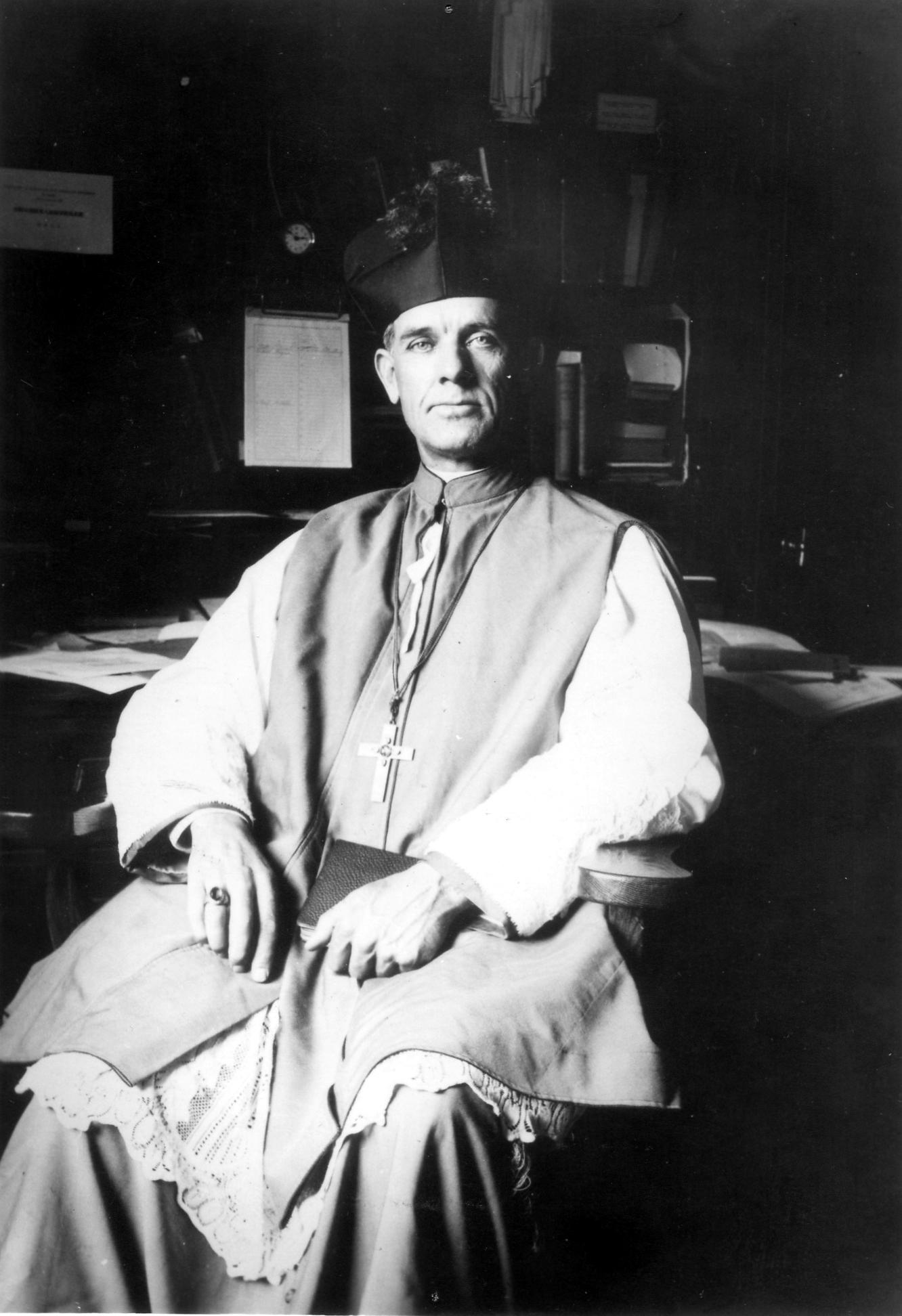
Founder
John Edward Morris (Korean name:Mok I-se)
In August 1924, Father John E. Morris, M.M., was appointed parish priest of Yeongyu, Pyeongannam-do. That same year, in October 1924, the Maryknoll Sisters arrived in the Diocese of Pyongyang, establishing a Korean branch in Yeongyu. They contributed to the mission by setting up small clinics, craft schools, and kindergartens, providing essential services to local communities and supporting the evangelization efforts of each parish.
In 1926, Father Morris formed a religious community in Yeongyu, consisting of seven young women who were drawn to consecrated life. He personally sponsored their education, ensuring they received the necessary schooling to enter religious life and serve as female missionaries. He also entrusted their spiritual and vocational formation to the Maryknoll Sisters, who guided them in their preparation for missionary service.
In April 1930, Father John E. Morris, M.M., was elevated to the rank of Monsignor and appointed as the 2nd Prefect of Pyongyang, succeeding Monsignor Patrick J. Byrne (Bang Il-eun), the first Prefect of the diocese.
Upon assuming his new role, Monsignor Morris sought to understand the relationship between Catholicism and Protestantism in the Diocese of Pyongyang. Recognizing the significance of interfaith dialogue, he prioritized engagement with Protestants, fostering mutual respect and exchanges. His efforts led to a significant number of Protestant believers converting to Catholicism, contributing to the steady growth of the Catholic community in the Pyongyang diocese.
In 1926, Father Morris formed a religious community in Yeongyu, consisting of seven young women who were drawn to consecrated life. He personally sponsored their education, ensuring they received the necessary schooling to enter religious life and serve as female missionaries. He also entrusted their spiritual and vocational formation to the Maryknoll Sisters, who guided them in their preparation for missionary service.
In April 1930, Father John E. Morris, M.M., was elevated to the rank of Monsignor and appointed as the 2nd Prefect of Pyongyang, succeeding Monsignor Patrick J. Byrne (Bang Il-eun), the first Prefect of the diocese.
Upon assuming his new role, Monsignor Morris sought to understand the relationship between Catholicism and Protestantism in the Diocese of Pyongyang. Recognizing the significance of interfaith dialogue, he prioritized engagement with Protestants, fostering mutual respect and exchanges. His efforts led to a significant number of Protestant believers converting to Catholicism, contributing to the steady growth of the Catholic community in the Pyongyang diocese.
Prefect John E. Morris, M.M., and his mission team regularly organized doctrine seminars, lay meditation sessions, and retreats, fostering the spiritual growth of the faithful. They held a profound devotion to the Korean martyrs, instilling in their parishioners the spirit of martyrdom and deepening their commitment to the faith.
In 1934, they launched the Pyongyang Diocese magazine, originally titled Catholic Research Lectures (later renamed Catholic Research and eventually Catholic Chosun). This publication provided a wide range of educational materials, including Bible studies, Church teachings, doctrine, spiritual life, Korean Church history, world Church history, and Catholic news.
At a time when Korea was under Japanese colonial rule, this magazine played a crucial role not only in strengthening the faith of Korean Catholics but also in promoting national consciousness, offering a source of hope and identity amidst oppression.
In 1934, they launched the Pyongyang Diocese magazine, originally titled Catholic Research Lectures (later renamed Catholic Research and eventually Catholic Chosun). This publication provided a wide range of educational materials, including Bible studies, Church teachings, doctrine, spiritual life, Korean Church history, world Church history, and Catholic news.
At a time when Korea was under Japanese colonial rule, this magazine played a crucial role not only in strengthening the faith of Korean Catholics but also in promoting national consciousness, offering a source of hope and identity amidst oppression.
As the Prefect of Pyongyang, John E. Morris, M.M., oversaw the expansion of various missionary activities in the diocese. Recognizing the need for a native religious order, he worked to establish a women’s congregation rooted in the local Church.
On June 27, 1932, he founded the Sisters of Our Lady of Perpetual Help, the first indigenous religious order in Korea—established by Koreans, for Koreans, rather than by foreign missionaries.
As the Prefect of Pyongyang, John E. Morris, M.M., faced significant friction with the Japanese government, with the Archbishop stationed in Japan, and even with his fellow missionaries in the Korean branch of the Maryknoll Society over the issue of Shinto shrine worship. His firm opposition to policies that conflicted with Catholic doctrine placed him in a difficult position. Eventually, citing health reasons, he announced his resignation as the Prefect of Pyongyang in July 1936. His resignation was accepted by both the Superior General of the Maryknoll Society and the Vatican, and he returned to the United States in September 1936.
Despite leaving Korea, his heart remained with the Korean people. In April 1937, fulfilling his own wish, he moved to Kyoto, Japan, where he single-handedly ministered to 80,000 Korean Catholics at the Kawaramachi Central Cathedral. He devoted himself especially to visiting the poor and the sick, continuing his mission of service.
A powerful testimony from a nun who lived with him reveals the depth of his love for Korea: he secretly celebrated Mass with the Taegeukgi (Korean national flag) hidden under the altar cloth, a quiet yet profound act of resistance and devotion to the Korean people suffering under Japanese rule.
On June 27, 1932, he founded the Sisters of Our Lady of Perpetual Help, the first indigenous religious order in Korea—established by Koreans, for Koreans, rather than by foreign missionaries.
As the Prefect of Pyongyang, John E. Morris, M.M., faced significant friction with the Japanese government, with the Archbishop stationed in Japan, and even with his fellow missionaries in the Korean branch of the Maryknoll Society over the issue of Shinto shrine worship. His firm opposition to policies that conflicted with Catholic doctrine placed him in a difficult position. Eventually, citing health reasons, he announced his resignation as the Prefect of Pyongyang in July 1936. His resignation was accepted by both the Superior General of the Maryknoll Society and the Vatican, and he returned to the United States in September 1936.
Despite leaving Korea, his heart remained with the Korean people. In April 1937, fulfilling his own wish, he moved to Kyoto, Japan, where he single-handedly ministered to 80,000 Korean Catholics at the Kawaramachi Central Cathedral. He devoted himself especially to visiting the poor and the sick, continuing his mission of service.
A powerful testimony from a nun who lived with him reveals the depth of his love for Korea: he secretly celebrated Mass with the Taegeukgi (Korean national flag) hidden under the altar cloth, a quiet yet profound act of resistance and devotion to the Korean people suffering under Japanese rule.
In 1959, John E. Morris, M.M., returned to Korea and served as an assistant priest in the Incheon Diocese. Two years later, in 1961, he reunited with the Sisters of Our Lady of Perpetual Help, which had relocated its headquarters to Heukseok-dong, Seoul, following a period of refuge in Busan during the war.
Recognizing his foundational role, the congregation began searching for their founder in the 1970s, inspired by the renewal of religious life following the Second Vatican Council.
Even after his passing, Morris, M.M., remains with the congregation as a ‘prayer partner’, just as he had expressed during his lifetime.
Recognizing his foundational role, the congregation began searching for their founder in the 1970s, inspired by the renewal of religious life following the Second Vatican Council.
Even after his passing, Morris, M.M., remains with the congregation as a ‘prayer partner’, just as he had expressed during his lifetime.